

You can legally sell a jointly owned property in Texas, but the process depends on how the property is titled, whether the co-owners agree, and what legal rights each owner has.
The three primary options for selling a jointly owned property include:
- Selling the property by mutual agreement if all co-owners are willing to sell.
- Buying out another owner’s ownership interest if one owner wants to keep the property.
- Filing a partition action when co-owners cannot reach an agreement.
A co-owner can also sell their property interest, but this is less common because the buyer would become a co-owner with the remaining owners and generally could not make decisions affecting the entire property without their involvement.
The best solution depends on the property’s ownership structure, whether marital or other property rights apply, the relationship between the co-owners, and whether everyone is willing to cooperate. If co-owners cannot agree on which path to take, mediation may help them reach a voluntary resolution without court involvement.
Below, we’ll explain each option, outline the selling process, and cover what to do if disputes arise. If all owners decide to sell, Texas Home Buyers can help simplify the process by purchasing jointly owned properties as-is, with flexible closing timelines and no repairs, commissions, or closing costs.
Steps for Selling a Jointly Owned Property in Texas
Selling a jointly owned property requires communication, cooperation, and a clear understanding of each owner’s rights and responsibilities. While every situation is different, most sales follow the same general process, whether the property was inherited, awarded during a divorce, or purchased jointly.
Step 1: Determine How the Property Is Owned
Before taking any steps toward a sale, review the property’s deed to determine how it is owned. The ownership structure can affect each owner’s legal rights, whether all co-owners must approve the sale, how ownership interests are transferred, and how sale proceeds may ultimately be divided.
To understand your rights, first determine how legal title to the property is held. If you’re married, you’ll also need to consider whether Texas community property laws affect ownership rights. The deed generally identifies who holds legal title and the nature of their ownership interests, while Texas marital-property rules may give a spouse rights in property even if the spouse’s name does not appear on the deed.
Common ownership arrangements include:
| Ownership Type | How It Works | How It May Affect the Sale |
|---|---|---|
| Joint tenancy with right of survivorship | When one owner dies, their ownership interest automatically passes to the surviving owner or owners if the survivorship agreement meets Texas legal requirements. | The surviving owner automatically receives the deceased owner’s interest, avoiding probate. All living owners generally must agree to sell the property. |
| Tenancy in common | Each owner holds a separate ownership interest that can be equal or unequal and may be transferred or inherited independently. | Each owner can transfer or inherit their share separately, but all co-owners generally need to coordinate before selling the entire property. |
| Community property | Most property acquired during marriage is considered community property under Texas law unless it qualifies as separate property. | Community property rights may mean both spouses must participate in the sale, even if only one spouse is listed on the deed. |
Can You Sell a House Without Your Spouse’s Consent in Texas?
It depends on the circumstances, including how title is held, when and how the property was acquired, and whether Texas community-property or other marital-property rights apply. Texas homestead law is especially important. If the property is the spouses’ homestead, one spouse generally cannot sell, convey, or encumber it without the other spouse joining in the transaction, even when the home is one spouse’s separate property.
Property owned before marriage may be considered separate property, while property acquired during marriage may be subject to Texas community property laws, even if only one spouse is listed on the deed. Because every situation is different, reviewing the deed and understanding the property’s ownership history are important first steps.
If you’re unsure whether your spouse’s consent is required to sell, speaking with a qualified Texas real estate attorney can help clarify your rights before moving forward.
Understanding the ownership structure early can help prevent disputes later in the process, particularly when inherited property, divorce, or multiple family members are involved. If there are questions about ownership interests, separate property claims, or property rights, reviewing the deed or speaking with a qualified Texas real estate attorney may help clarify each owner’s rights before moving forward.

Step 2: Determine Whether All Owners Agree to Sell
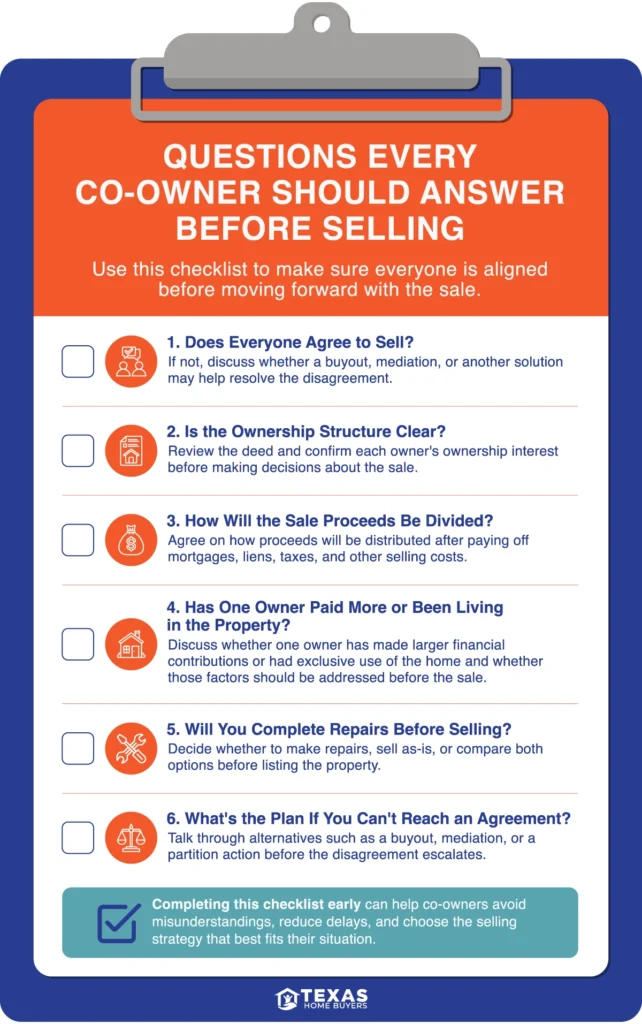
Before choosing a selling strategy, determine whether all co-owners are willing to move forward with a sale. An open discussion early in the process can help identify each owner’s goals, clarify expectations, and reduce the likelihood of misunderstandings later.
Topics to discuss may include:
- Whether everyone wants to sell, keep, or rent the property
- The property’s estimated fair market value
- Any needed repairs or outstanding expenses
- How sale proceeds will be divided
- Each owner’s preferred timeline for selling
What If One Owner Doesn’t Want to Sell?
If one owner wants to sell and another doesn’t, understanding the reason for the disagreement can help determine the best path forward. In some cases, a buyout or mediation may help the owners reach a voluntary agreement. If those efforts are unsuccessful, a partition action may provide a legal remedy under Texas law.
Step 3: Choose the Best Path Forward
After all owners understand their options, the next step is choosing the approach that best fits the situation. Some co-owners are able to move forward with a voluntary sale, while others may decide a buyout, mediation, or partition action is more appropriate.
| Option | Best for | How It Works |
|---|---|---|
| Sell the property together | Co-owners who want to sell and divide the proceeds | The property is sold through a real estate agent or cash buyer, and the sale proceeds are distributed according to each owner’s ownership interest. |
| Buy out co-owners’ share of property | When one owner wants to keep the property | One owner purchases another owner’s ownership interest, allowing the remaining owner to retain the property. |
| Use mediation | Owners who want to resolve a dispute without court involvement | A neutral third party helps facilitate discussions and explore voluntary solutions, such as a sale or buyout. |
| Pursue a partition action | Owners who cannot reach an agreement | A court may divide or order the sale of the property after other options have been exhausted. |
Choosing the right option depends on each owner’s goals, the relationship between the co-owners, and whether everyone is willing to work toward a voluntary resolution. If all owners ultimately agree to sell, the process can move forward without court involvement.
Step 4: Complete the Sale and Divide the Proceeds
After the owners have agreed on a path forward, the property can move toward closing. If the home is sold, the sale proceeds are generally distributed according to each owner’s ownership interest after outstanding mortgages, liens, property taxes, and selling expenses have been addressed.
Discussing how proceeds will be divided before closing and maintaining clear records of shared expenses can help prevent misunderstandings. If all owners agree to sell, working with a cash buyer such as Texas Home Buyers may simplify the process by allowing the property to be sold as-is, with no repairs, commissions, or closing costs, and with a closing timeline that fits the owners’ needs. Most purchases close within 15 to 30 days, with some closing in as little as 5 days.
Understanding Partition Actions in Texas
A partition action, under Texas Property Code Chapter 23, is a legal process a co-owner may use to divide jointly owned property or seek a court-ordered sale. Texas law does not require co-owners to first attempt mediation, a buyout, or a voluntary sale, although owners often explore those alternatives before pursuing litigation. While partition actions are generally considered a last resort, they may provide a path forward when one owner wants to sell and another refuses.
Partition in Kind vs. Partition by Sale
Texas courts generally resolve partition cases in one of two ways: dividing the property or ordering it to be sold. Because most residential homes cannot be physically divided fairly, partition by sale is typically the more common outcome.
| Partition Method | What Happens | Typical Outcome |
|---|---|---|
| Partition in kind | The property is physically divided so each owner receives a separate portion. | More common for larger tracts of land that can be fairly divided |
| Partition by sale | The court orders the property to be sold and the proceeds distributed according to each owner’s ownership interest. | Most common for residential homes that cannot be practically divided |
What Happens After a Partition Action Is Filed?
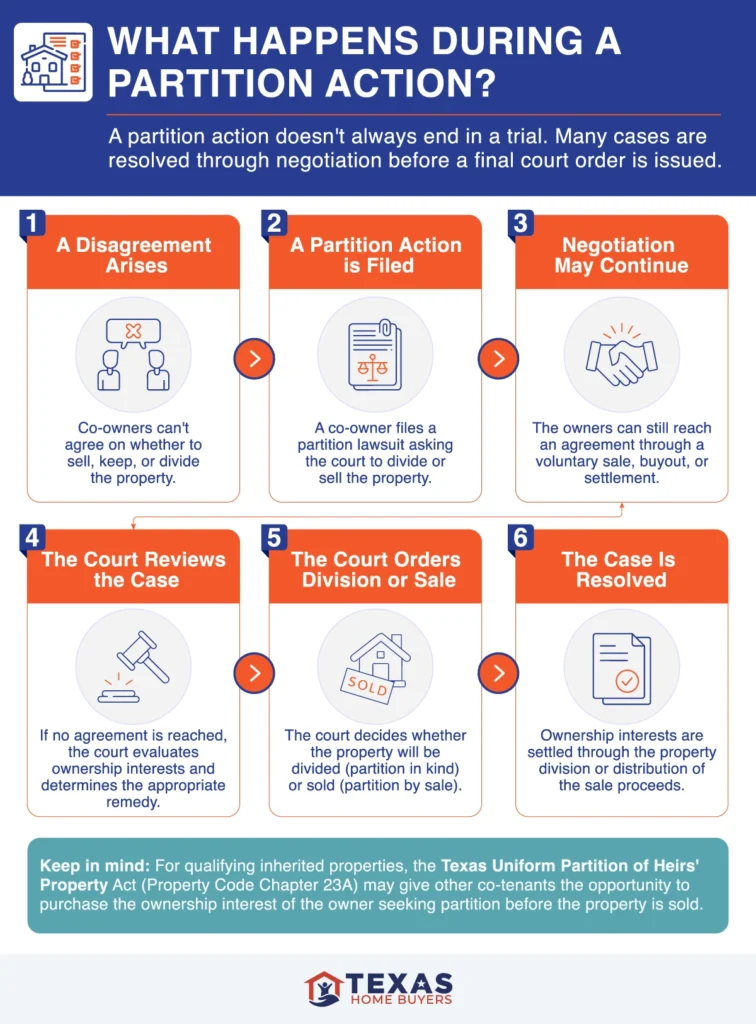
Filing a partition action does not necessarily mean the case will go to trial. Many disputes are resolved before a final court decision through a negotiated settlement, voluntary sale, or buyout.
To begin the process, a co-owner typically files a partition lawsuit in the district court or county court with jurisdiction over the property. The petition generally identifies the property, the co-owners, and each person’s ownership interest while asking the court to divide or sell the property under Texas law. Because partition actions involve legal procedures and court filings, working with a qualified Texas real estate attorney is often advisable.
If the case moves forward, the court will determine whether the property should be divided through a partition in kind or sold through a partition by sale. Because partition actions involve court proceedings, the process can take several months or longer depending on the complexity of the dispute, the court’s schedule, and whether the owners continue negotiating throughout the case.
For certain inherited properties, Texas provides additional protections through the Uniform Partition of Heirs’ Property Act (Texas Property Code Chapter 23A). Before ordering the sale of qualifying heirs’ property, the court must first determine whether the property is subject to Chapter 23A. If it is, other co-tenants may have the opportunity to purchase the ownership interest of the cotenant seeking partition before the property is sold, helping families preserve inherited property whenever possible.
Financial Considerations Before Selling a Jointly Owned Property
Selling a jointly owned property involves more than agreeing on a purchase price. Co-owners should also decide how ongoing expenses, existing financial obligations, and sale-related costs will be handled before closing. Addressing these questions early can help prevent disputes and keep the transaction moving forward.
| Expense | Is It Typically Shared? | Before You Sell |
|---|---|---|
| Property taxes | Usually | Determine whether any unpaid taxes need to be resolved before closing. |
| Mortgage payments | Usually | Decide who will continue making payments until the sale is complete. |
| Homeowners insurance | Usually | Maintain adequate coverage until ownership transfers. |
| Necessary repairs | Often | Agree on whether repairs will be completed before selling. |
| Renovations and improvements | Not always | Discuss major projects before investing additional money. |
| Utilities and maintenance | Depends | Decide who is responsible for ongoing costs until closing. |
Consider the Tax Implications of the Sale
In addition to dividing the sale proceeds, co-owners should consider whether the sale could trigger a capital gains tax. Whether taxes are owed depends on factors such as how the property was used, how long it was owned, whether it was inherited, and whether it qualifies as a primary residence. Some homeowners may qualify for a federal capital gains exclusion if they meet the IRS ownership and residency requirements.
Because every owner’s tax situation is different, it’s a good idea to consult a qualified tax professional before selling a jointly owned property, particularly if the home has appreciated significantly in value, has been inherited, or has been used as a rental or investment property.

Shared Expenses Don’t Always Mean Equal Responsibility
It’s common for co-owners to contribute differently toward mortgage payments, property taxes, insurance, repairs, and other property expenses. While many owners choose to split these costs, there isn’t always a legal requirement that every expense be divided equally. Responsibility may depend on the ownership arrangement, prior agreements, whether the property is separate or community property, and the circumstances surrounding each expense.
Document Financial Contributions Along the Way
If one owner pays more than the other toward the property’s ongoing expenses, keeping clear records can help avoid misunderstandings later. While those contributions don’t automatically change ownership interests, they may become relevant if the owners negotiate reimbursements or have questions about how sale proceeds should be distributed.
When to Consider Legal Guidance
Many jointly owned properties can be sold without court involvement, but some situations are more complex than others. If there are disputes over ownership rights, questions about the property’s title, or disagreements that prevent a voluntary sale, consulting a qualified Texas real estate attorney may help you better understand your options.
| Situation | How an Attorney May Help |
|---|---|
| Ownership or title disputes | Clarifies ownership rights and resolves title issues before selling |
| Divorce or community property questions | Explains how Texas community property laws may affect the sale |
| Inherited property disagreements | Helps resolve disputes between heirs or co-owners |
| Partition actions | Explains the legal process and represents your interests if litigation becomes necessary |
| Buyouts or settlement agreements | Prepares or reviews written agreements to help protect all parties involved |
While legal guidance may be appropriate in some situations, many co-owners are still able to reach an agreement through negotiation, mediation, a buyout, or a voluntary sale without prolonged court proceedings.
When a Cash Sale Makes Sense for Co-Owners
Not every jointly owned property needs to be listed on the open market. If all co-owners have agreed to sell, a cash home sale may offer a simpler alternative, particularly when the property needs repairs, has been inherited, or the owners want to avoid the time and uncertainty of a traditional listing.
Texas Home Buyers works with co-owners across Texas in a variety of situations, including inherited homes, divorce-related property sales, rental properties, and homes that have become difficult to manage. Because we purchase properties as-is, co-owners can often move forward without making repairs, preparing the home for showings, or paying real estate commissions or closing costs.
A cash sale may be worth considering if:
- All co-owners have agreed to sell quickly.
- The property needs significant repairs or updates.
- The home has been inherited by multiple heirs.
- One or more owners live out of town or out of state.
- The property is vacant or difficult to maintain.
- Co-owners are considering a partition action but would prefer to reach a voluntary resolution.
If a voluntary sale is possible, selling to Texas Home Buyers may help co-owners avoid a lengthy sales process while providing the flexibility to choose a closing date that works for everyone.
Helping Co-Owners Sell with Confidence
Selling a jointly owned property in Texas isn’t always straightforward, especially when co-owners have different goals or disagree about the property’s future. Understanding your ownership rights, exploring your available options, and communicating early can help you reach the best outcome while avoiding unnecessary delays or disputes.
If all owners agree to sell, or if a voluntary sale becomes the preferred alternative to a partition action, Texas Home Buyers can help simplify the process. We purchase jointly owned properties throughout Texas, provide fair cash offers, and work with multiple owners to coordinate a closing timeline that fits everyone’s needs.