
Selling a house without a realtor in Texas is entirely possible, and for many homeowners, it can be a practical way to save on listing commissions and maintain more control over the selling process. However, a successful for sale by owner (FSBO) sale also means taking responsibility for tasks that a real estate agent would typically handle, including pricing your home, marketing the property, coordinating showings, negotiating with buyers, completing the required paperwork, and managing the closing process.
A FSBO sale tends to work best for homeowners with a market-ready property, enough time to manage the sale, and the confidence to handle negotiations and paperwork. It can also be a practical option if you already have a buyer lined up, such as a family member, friend, neighbor, or tenant, allowing you to skip much of the marketing process. If your home needs significant repairs, you’re facing a major life event, or selling quickly is your top priority, another selling method may ultimately be a better fit.
At Texas Home Buyers, we believe homeowners should understand all of their selling options before making a decision. Whether you choose to sell your home on your own, work with a real estate agent, or sell directly to a cash buyer, the right approach depends on your goals, timeline, and property. Below, we’ll help you understand the FSBO process from start to finish so you can make an informed decision with confidence.
Is an FSBO Sale Right for You?
Before deciding how to sell your home, it’s important to choose the selling approach that best aligns with your priorities. The comparison below can help you quickly determine whether a traditional for sale by owner (FSBO) sale is the right fit, or whether another option may better suit your situation.
| If Your Priority Is . . . | A Good Option May Be . . . |
|---|---|
| Saving on listing agent commission and maintaining full control of the sale | Selling for sale by owner (FSBO) |
| Getting the highest possible sale price | Selling with a real estate agent or, if you’re comfortable managing every aspect of the sale yourself, a well-executed FSBO sale |
| Selling as quickly as possible | Selling to a cash buyer |
| Avoiding repairs, cleaning, staging, or selling a home with significant repair needs | Selling to a cash buyer |
| Minimizing the amount of work involved | Selling with a real estate agent or a cash buyer, depending on your priorities |
If an FSBO sale aligns with your goals, the next section explains exactly how to sell a house without a realtor in Texas, from pricing your home and marketing your listing to negotiating offers and closing the sale.
How to Sell a House Without a Realtor in Texas: Step-by-Step
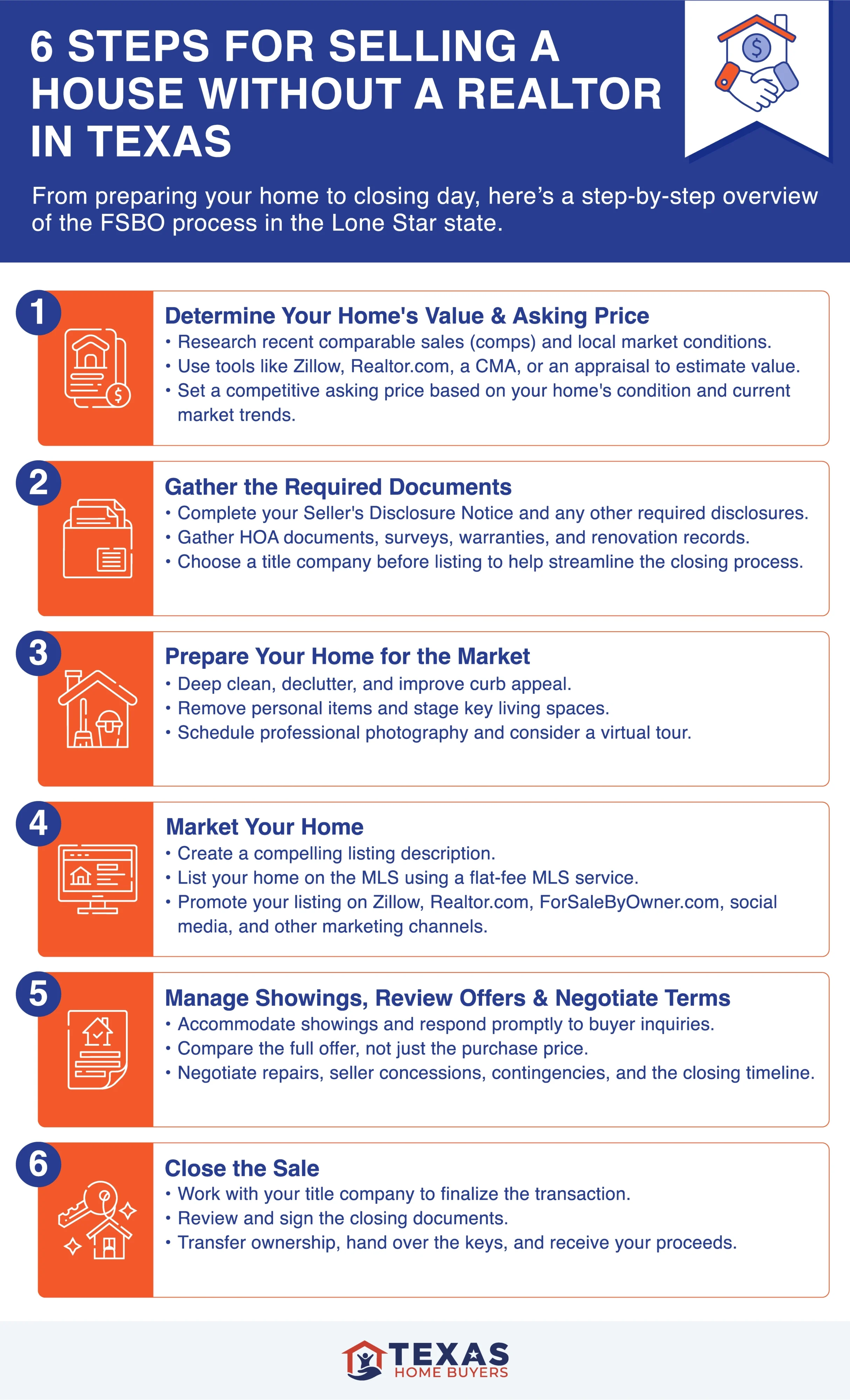
After you’ve decided a for sale by owner (FSBO) sale is the right fit, the process becomes much more straightforward. The five steps below walk you through everything from pricing your home and attracting buyers to negotiating offers and completing the closing process.
Step 1: Determine Your Home’s Value and Asking Price
Pricing your home correctly is one of the most important factors in a successful FSBO sale. A home that’s priced too high may struggle to attract buyers, while one that’s priced too low could leave money on the table.
Before setting your asking price, research your local market to understand what similar homes are actually selling for, not just what they’re listed for. Looking at recent comparable sales, or comps, can help you establish a realistic price based on current buyer demand.
When comparing your home to others, remember that square footage is only one factor. Buyers also consider a variety of characteristics that can significantly influence a home’s value, including:
- Location and neighborhood
- Square footage and floor plan
- Number of bedrooms and bathrooms
- Age and overall condition
- Recent renovations or upgrades
- Lot size and outdoor features
- School district and nearby amenities
- Current local market conditions
Before finalizing your listing price, take an honest look at your home’s condition. Deferred maintenance, outdated finishes, or needed repairs can affect both your home’s value and buyer demand. While some improvements may help justify a higher asking price, others may not provide a strong return on investment. If your home requires extensive repairs and you don’t want to invest additional time or money before selling, you may also want to consider selling as-is to a cash buyer.
The resources below can help you estimate your home’s market value and establish a competitive asking price.
| Pricing Resource | Best for | What to Keep in Mind |
|---|---|---|
| Comparable sales (comps) | Establishing a baseline value using recently sold homes similar to yours | Focus on homes with similar size, age, condition, features, and location that have sold within the past few months. |
| Zillow & Realtor.com | Researching recent sales, active listings, and neighborhood market trends | Automated home values can be a helpful starting point, but they shouldn’t be your only pricing tool. |
| Comparative Market Analysis (CMA) | Receiving a professional estimate based on local market data | Some real estate professionals provide a CMA at no cost, while others may charge a fee (often around $100–$200). |
| Licensed appraiser | Obtaining an independent valuation, particularly for unique or higher-value properties | A professional appraisal typically costs $425–$650 and can provide additional confidence when pricing your home. |
As you determine your listing price, remember that the goal isn’t simply to price your home as high as possible. A well-researched, competitive price often generates more buyer interest, increases showing activity, and can lead to stronger offers than an overpriced listing that sits on the market.
Step 2: Gather the Required Documents
Before you list your home, gather the documents buyers are likely to request during the sale. Having everything organized ahead of time can help prevent delays, answer buyer questions more quickly, and keep your transaction moving once you receive an offer.
The exact paperwork you’ll need depends on your property, but most for sale by owner (FSBO) sellers in Texas should have the following documents ready before listing:
FSBO Document Checklist
- Seller’s Disclosure Notice: Texas Property Code § 5.008 requires sellers to disclose any known material defects or issues with the property, although some exceptions apply.
- Lead-based paint disclosure (if applicable): If your home was built before 1978, this form is required under federal law.
- HOA documents (if applicable): If your property is part of a homeowners association, buyers may request HOA information, governing documents, and resale certificates.
- Property survey (if available): Providing an existing survey may save time and help reduce costs during the transaction.
- Utility or renovation records (optional): Recent utility bills, warranties, or documentation of major repairs and improvements can help answer buyer questions and build confidence.
It’s also a good idea to choose a title company before you receive an offer. A title company plays an important role in the closing process by verifying ownership, identifying title issues, preparing the closing documents, coordinating escrow, and recording the property deed. Researching your options ahead of time can help you avoid last-minute decisions and keep the transaction moving smoothly once you’re under contract.
Taking the time to organize your documents and select a title company before your home goes on the market can make the rest of the selling process more efficient and help you respond quickly as buyers begin expressing interest.
Step 3: Prepare Your Home for the Market
Once you’ve determined your asking price and gathered the necessary documents, the next step is presenting your home in the best possible light. A clean, organized, and well-photographed home is more likely to attract buyers, generate more showings, and make a strong first impression.
Before listing your home, focus on creating a space that allows buyers to picture themselves living there. Deep clean every room, declutter countertops and closets, remove personal items like family photos, and improve curb appeal by mowing the lawn, trimming landscaping, and tidying the entryway. These relatively inexpensive improvements can have a significant impact on how buyers perceive your home.
High-quality photos are equally important. Since most buyers begin their home search online, your listing photos are often their first impression of the property. While some FSBO sellers choose to take their own photos, professionally photographed listings often appear more polished and can help your home stand out from competing listings. Professional photography typically costs $150 to $350. If hiring a photographer isn’t in your budget, use a high-quality camera or smartphone, photograph each room in natural light, and capture clean, wide-angle images that accurately showcase the home’s layout and features.
If your home has a unique layout, high-end finishes, or outdoor living spaces, adding a virtual tour can provide buyers with additional context and encourage them to schedule a showing.
Home Preparation Checklist
- Complete any worthwhile minor repairs.
- Deep clean the entire home.
- Declutter and depersonalize each room.
- Improve curb appeal by tidying the landscaping and entryway.
- Stage your home to highlight its best features.
- Take high-quality listing photos or hire a professional photographer.
- Consider adding a virtual tour if it helps showcase the property.
Preparing your home before listing gives buyers a stronger first impression and gives your marketing efforts the best chance of success.
Step 4: Market Your Home
Once your home is ready and your paperwork is organized, it’s time to get your listing in front of as many qualified buyers as possible. The more exposure your home receives, the greater your chances of attracting strong offers.
Start by creating a detailed listing that accurately describes your home’s features, recent updates, and unique selling points. Include the professional photography and virtual tours you prepared earlier, and make sure your listing price and property details are consistent across every platform where your home appears.
One of the best ways to maximize your home’s exposure is by listing it on the Multiple Listing Service (MLS) through a third-party company. Because most real estate websites and agents rely on the MLS, having your home listed there can significantly increase its visibility to both buyers and buyer’s agents. Many FSBO sellers use flat-fee MLS services, which allow you to access the MLS without paying a full listing commission.
To maximize exposure, market your home across multiple channels rather than relying on a single website.
| Marketing Channel | Why It Matters |
|---|---|
| Zillow | One of the most popular home search websites, making it an important platform for reaching active buyers |
| Realtor.com | Expands your listing’s visibility to another large audience of home shoppers |
| ForSaleByOwner.com | Specifically designed for homeowners selling without a real estate agent |
| Flat-fee MLS services | Typically cost $100–$500 and can place your home on the Multiple Listing Service (MLS), significantly increasing exposure to buyers and buyer’s agents without paying a traditional listing commission |
| Social media & local community groups | Help generate additional visibility and word-of-mouth interest |
| Open houses & private showings | Allow prospective buyers to experience the home in person and ask questions before making an offer |
As inquiries begin coming in, respond promptly, keep your listing information up to date, and make scheduling private showings as easy as possible. An organized, responsive selling experience can leave a positive impression on buyers and help maintain momentum throughout the sale.
Step 5: Manage Showings, Review Offers & Negotiate Terms
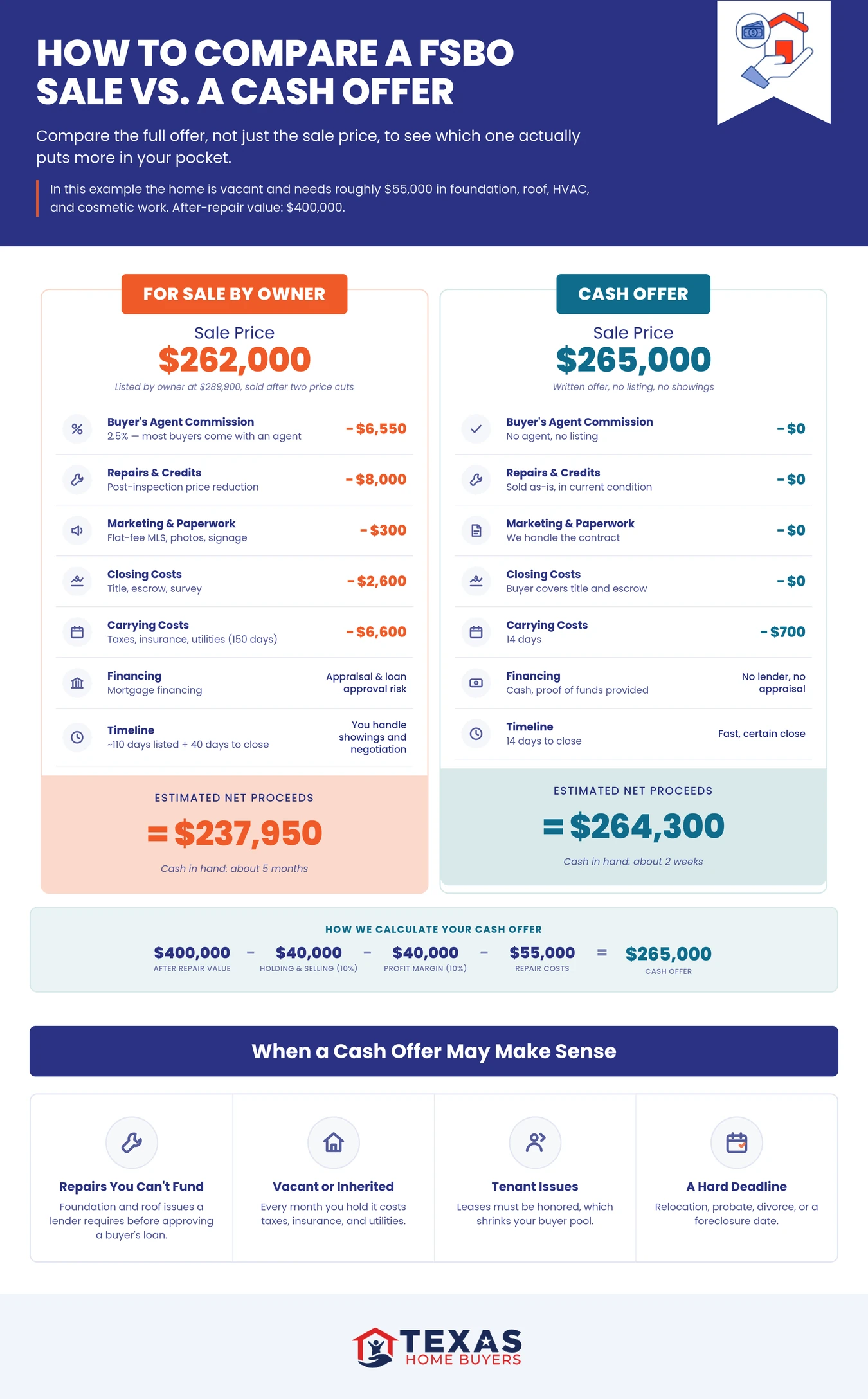
Once your home is on the market, your focus shifts from attracting buyers to finding the right one. While the highest offer may seem like the obvious choice, it’s important to evaluate the entire offer, not just the purchase price.
As buyers begin scheduling private showings or attending open houses, be prepared to answer questions about the property and accommodate showing requests whenever possible. The easier you make it for buyers to view your home, the more likely you are to generate interest and receive competitive offers.
When offers start coming in, carefully review the terms of each purchase agreement. A lower offer with fewer contingencies may ultimately leave you with more money than a higher offer that includes repair requests, seller concessions, or a lengthy closing timeline.
For example: A $395,000 offer with no repair requests and a quick closing could result in higher net proceeds than a $400,000 offer that requires you to pay $10,000 in repairs and closing cost credits.
Similarly, if substantial repairs are needed, your house may be on the market for awhile, leading to price reductions and carrying costs. Every situation is truly unique, so make sure to weigh your options and understand what costs you’ll incur.
| What to Evaluate | Why It Matters |
|---|---|
| Purchase price | A higher offer isn’t always the best offer if other terms are less favorable. |
| Earnest money deposit | A larger earnest money deposit often signals a buyer who’s serious about completing the purchase. |
| Financing | Cash offers typically involve fewer delays and don’t depend on mortgage approval. |
| Contingencies | Financing, appraisal, and inspection contingencies can affect both your timeline and the likelihood of closing. |
| Closing timeline | Make sure the timeline aligns with your moving plans and any other important deadlines. |
| Seller concessions | Credits toward closing costs or repair requests can reduce your net proceeds. |
After selecting the strongest offer, you’ll negotiate any remaining terms before signing the final purchase contract. Common negotiation points include the purchase price, repair requests following the home inspection, seller concessions, and the closing date.
Most Texas real estate transactions are completed using standardized forms published by the Texas Real Estate Commission (TREC), including purchase contracts and required addenda. Even if you’re selling without a realtor, you must use the appropriate TREC forms. If you have questions about which forms apply to your transaction or how to complete them, consider consulting a real estate attorney before signing.
Once both parties have agreed to the terms and the contract has been executed, you’re ready to move into the closing process.
Step 6: Close the Sale
After you’ve accepted an offer and signed the purchase contract, the final step is completing the closing process. While several tasks still need to happen before ownership officially transfers, much of the coordination is handled by the title company.
Most Texas home sales follow a similar sequence after a contract has been signed:
- The title company begins the closing process. The title company verifies ownership, resolves any title issues, and prepares the closing documents needed to complete the transaction.
- The buyer completes any remaining contract requirements. Depending on the terms of the contract, this may include final financing approval, an appraisal, a home inspection, or any agreed-upon repairs.
- The buyer completes a final walkthrough. Shortly before closing, the buyer will typically perform a final walkthrough to confirm the property’s condition matches the terms of the agreement.
- Review and sign the closing documents. Before signing, carefully review your closing statement to verify the purchase price, credits, closing costs, and other financial details are accurate.
- Transfer ownership and receive your proceeds. Once all documents have been signed and funds have been distributed, the property deed is recorded, officially transferring ownership to the buyer and completing the sale.
Although much of the closing process takes place behind the scenes, responding promptly to requests from the title company and reviewing documents carefully can help ensure your sale closes on schedule.
The Risks of Selling a House Without a Realtor
Selling a house without a realtor can save on real estate commission, but you’ll also take on responsibilities that would normally be handled by an agent. Understanding the most common challenges ahead of time can help you avoid costly mistakes and improve your chances of a successful sale.
The most common risks of a for sale by owner (FSBO) sale include:
- Pricing your home incorrectly: Setting your asking price too high can reduce buyer interest, while pricing it too low could leave money on the table. Research recent comparable sales, review local market trends, or obtain a comparative market analysis (CMA) or professional appraisal before listing your home.
- Limited buyer exposure: Without a real estate agent, it’s your responsibility to market the property effectively. Listing your home across multiple platforms and using flat-fee MLS services can help increase visibility through the Multiple Listing Service (MLS).
- Negotiating unfavorable terms: The highest offer isn’t always the strongest offer. Carefully review the entire purchase agreement, including contingencies, financing, seller concessions, and the proposed closing date before making a decision.
- Making paperwork or legal mistakes: Selling a home involves contracts, disclosures, and other important documents. If you’re unsure about any legal requirements or contract terms, consider consulting a real estate attorney before moving forward.
- Taking longer to sell: A home that isn’t priced competitively, marketed effectively, or shown consistently may stay on the market longer than expected. Preparing your home thoroughly and responding promptly to buyer inquiries can help keep your sale moving.
While many homeowners successfully sell their homes without a realtor, understanding these potential challenges can help you prepare for the process and decide whether an FSBO sale is the right approach for your situation.
How Much Tax Do You Pay When Selling a House in Texas?
Texas does not charge a state capital gains tax on the sale of real estate. However, depending on your situation, you may still owe federal capital gains tax when you sell your home.
If the home you’re selling has been your primary residence for at least two of the past five years, you may qualify for the federal capital gains tax exclusion. This allows many homeowners to exclude up to $250,000 in capital gains if filing individually or up to $500,000 if married and filing jointly, provided they meet IRS eligibility requirements.
In addition to potential capital gains taxes, you’ll also pay certain transaction-related expenses at closing, such as your share of closing costs and any prorated property taxes. These aren’t taxes on the sale itself, but they can affect your final proceeds.
Tax rules can vary depending on factors like whether the property is your primary residence, a rental property, or an inherited home. If you’re unsure how the sale could affect your tax situation, it’s a good idea to consult a qualified tax professional before closing.
When a Cash Buyer May Be the Better Option
Selling FSBO without a realtor can be a great option if you have the time and desire to manage the process yourself. However, if your priority is speed, convenience, or avoiding repairs, selling directly to a cash buyer may be a better fit.
| Your Situation | Why a Cash Buyer May Make Sense |
|---|---|
| Your home needs significant repairs. | Sell the property as-is without spending time or money on renovations before listing. |
| You need to sell quickly. | Cash sales often close much faster than traditional home sales because there’s no lender involved. |
| You’ve inherited a property. | Avoid preparing, updating, or maintaining a home you don’t plan to keep. |
| You’re facing foreclosure or financial hardship. | A faster sale may help you move on more quickly and avoid the uncertainty of listing on the open market. |
| You’re relocating or going through a major life transition. | A direct cash sale can simplify the process when time and flexibility are limited. |
| You want to avoid showings, open houses, and negotiations. | Sell directly to one buyer instead of marketing the home and managing multiple offers. |
A cash sale isn’t necessarily the right choice for every homeowner, just as selling without a realtor isn’t always the best fit. The right approach depends on your priorities, your property’s condition, and your desired timeline.
If you’re looking for a faster, simpler way to sell your home, Texas Home Buyers purchases houses throughout Texas in any condition. We buy homes as-is, charge no agent commissions or hidden fees, and can often close in as little as 15 to 30 days, allowing you to sell on a timeline that works for you.
Sell Your Texas Home Your Way
Selling a house without a realtor can be a great way to save on listing commissions and maintain greater control over the selling process, but it also requires the time, organization, and confidence to manage each stage of the transaction successfully.
If a for sale by owner (FSBO) sale aligns with your goals, the steps in this guide can help you navigate the process with confidence. If your priority is selling quickly, avoiding repairs, or simplifying the experience, selling to a cash buyer may be the better choice.
At Texas Home Buyers, we purchase houses as-is throughout Texas, with no commissions, no hidden fees, and no obligation. If you’re ready to explore your options, contact us today for a free cash offer and see how simple selling your home can be.